DESIGNER PUPPYS: Everything you wanted to know about raising designer or mixed breed dogs,
featuring The BOYZ: Prince Alvin His Cuteness (on left) and Sir Simon The Sad, Cockapoo pups.

Showing posts with label canine luxating patella. Show all posts

Wednesday, August 1, 2012

Selecting the Best Vet for You and Your Dog

After four surgeries and endless trips to the vet for various ailments for two dogs, I am convinced that the selection of a vet is an all-important factor to your dog’s well-being.

It’s well worth taking the time to develop a good relationship with a quality vet.

Where to Start
You could pick a vet from the Yellow Pages or from an Internet search; but would you pick your own doctor from the same source?

My guess is that you’d want a doctor comes highly recommended – someone you can trust.

And the vet isn’t just your dog’s doctor; he’s also the dentist, manicurist, psychologist, and a friend. When you roll all these things up into one, you can see why you need to spend time confirming that you’ve made the right choice.

The best place to start looking for a vet is by referral. If you know friends or relatives who take good care of their dogs, then that’s a place to start. Ask them who they’d recommend, and why. This last one is very important, because everyone has different priorities: for example, your friends like their own vet because he is a specialist in their own particular breed; or they don’t charge very much; or the office is only a five minutes’ drive. Their priorities are not necessarily yours, so it’s a good idea to make sure that your values coincide with the person giving the referral.

Another place to find a vet is through local training clubs (agility, herding classes, police K-9 academies, etc.) These organizations are almost guaranteed to place a great deal of importance on high-quality veterinary care, because the health and well-being of their dogs is such a priority.

Once you’ve compiled a list of vets that you’re interested in pursuing, call up the vet’s office and explain that you want to find a regular vet for your dog(s). Ask if you can you come in for a quick chat, introduce your dog, and have a look at the facility.

Visit the Vet’s Office
Before you decide to align yourself and your dog with a particular vet, test the waters first. Ideally, you want a chance to talk to the vet, and discuss his or her philosophies and approach to dog care.

Also, this is critical - if your dog ever really needs vet care (if there’s an emergency, or if he needs an urgent short-term appointment), you want to be sure that you’ve made the best possible choice as far as his health and comfort levels are concerned. Neither of you should be subjected to undue stress at a time like that – and you can avoid grief by spending a bit of time in preparation.

Questions to Ask the Vet
While you’re at the vet’s office, you’ll be assessing your potential vet’s overall attitude and approach to health care and animals; and you’ll also probably want answers to some specific questions.

Here’s a list of useful questions to help you on your way:

How many vets are there on staff?
If you need to make an urgent appointment, you don’t want to be waiting around while precious minutes tick past. Ideally, there’ll be at least two qualified veterinarians on hand, not just technicians or assistants.

What kind of testing and analysis capabilities does the clinic have?
If they have to send away to a lab for test results, it means that the results are going to be delayed. If your dog is very sick, time is an important factor: it’s best if the clinic has at least blood-analysis testing on hand.

What after-hours services are available?
A lot of clinics close the doors in the evenings and on weekends, which means that if there’s an emergency, you’ll have to go somewhere else – and subject your dog and yourself to an unfamiliar vet. (If you don’t mind this, then that’s fine; but be aware that in a high-stress situation when emotions are running high, it’s reassuring for your dog and yourself to deal with someone familiar.)

What’s their price range? How are payments made? Is there a facility for payment plans in case of unexpected vet bills?
The payment-plan option is particularly important. Even with pet insurance, vet bills can sometimes be high – and not everyone has the resources to deal with large vet bills. Ask the vet how they handle these situations.

How up-to-date is the staff with advances in the industry? Do the vet, the technicians, and the assistants attend seminars and workshops regularly?
The field of medical care is always moving forward. Responsible vets make the effort to keep up with the times, and see that their staff do, too.

Making the Right Selection
When you choose a vet, you’re balancing convenience and quality. There’s no right or wrong vet for you and your dog. That’s why making the choice can be so confusing. There are plenty of vets to choose from, and they’re all different!

Even though it’s tempting to go for the one right around the corner with the lowest prices, it is worthwhile taking the time to shop around. Your dog is dependent on you for his healthcare – and if you take him seriously as a family member, you’ll want to do the best thing by him.

A good vet knows how to take care of you as well as your dog. The relationship that you have with your vet will hopefully be one that’s based around a healthy mutual respect and positive synergy - there should be very little room for misunderstanding. When the two of you see eye to eye, it makes caring for your dog much easier.

Further Reading
For a comrehensive survival guide on stress-free dog care, including detailed information on when your dog needs to see the vet, how to respond to pet emergencies, dog First Aid, and all common health problems, check out the Ultimate Guide to Dog Health. It’s a complete handbook on dog health care, and teaches you how to take a proactive and prepared approach to dog ownership.

Other resources from the authors own experience:
Anal Gland Removal Surgery - Alvin's Story
Simon's Story - Canine Luxating Patella Surgery and Recovery

Material for this article courtesy of Kingdom of Pets
Photo from flickr.com: Veterinarian from Army Medicine

Friday, March 2, 2012

Friday, June 3, 2011

Does Your Pup Have A Trick Knee? Limping Or Walking Stiff-Legged? Read Simon's Story To Find Out About Canine Luxating Patella!

If your dog walks like Simon does in the first few seconds of this video,


Then your precious pup may have a condition called trick knee in dogs (canine luxating patella). Simon did. And he was only a year old when the video was taken.

Before you get panicy, your dog may NOT need surgery to correct the condition. Simon did or he was eventually going to be permanently lame or blow out his ACL (anterior cruxiate ligament).

Regardless of whether your dog requires surgery or not, you're gonna want to read Simon's Story.

Why?

So you know what questions to ask your vet.

So you understand if you can postpone or forget about surgery.

If your dog does require surgery, you'll know what to expect pre- and post-surgery.

Recovery is a critical time period. Find out what problems can arise.

Read Simon's Story - you'll be glad you did!

Monday, April 18, 2011

Canine Luxating Patella (Trick Knee) Surgery And Recovery - Simon's Story

So your pet has been diagnosed with luxating patella or trick knee or floating kneecap. His kneecap keeps sliding out of its bony groove. Your thoughts are likely as follows:

Is he going to be lame for the rest of his life?

Is surgery necessary?

What happens if your dog doesn't get surgery?

Suppose I elect surgery - how long is the recovery period?

What if the repair doesn't work?

And then there's the financial aspect (sad, but true). Can you afford thousands of dollars in vet and animal hospital bills?

Want to get the answers?

You can surf the net for a few hours and get some of these questions answered.

Or you can read Simon's Story - from the time he was diagnosed with luxating patella in dogs to the end of his recovery period.

Once you finish Simon's Story, you'll know if you should pursue the non surgical route, what questions to ask your vet, and how to make sure your pet has a successful recovery.

Here's excerpts from Simon's Story - Click the pic and check it out!


Thursday, January 13, 2011

Another Opinion On Canine Luxating Patella (Trick Knee Or Floating Kneecap) Surgery

Wish I had access to Dr. Karen Becker's opinion on canine luxating patella surgery BEFORE Simon went under the knife!

A little background - Simon had the surgery for luxating patella last summer. His recovery period (the most critical time frame for successful surgery) was 10 weeks. You can read about Simon's surgery and recovery by clicking this link: http://vmills.hubpages.com/hub/Luxating-Patella-In-Dogs-Diagnosis-Surgery-and-Recovery.

Simon's condition was diagnosed as grade 1 - the mildest form. The surgeon did say we could wait, but the prognosis included arthritis and possible Anterior Cruxiate Ligament tear. We opted for the expensive surgery and the L-O-N-G recovery period.

Dr. Becker, a holistic veterinarian, is clearly conservative. She recommends the following:
"If your dog can’t walk or run normally without having intense pain, you need to consider surgery in correcting the knee cap issue."

In other words, if the dog has grade 3 or 4 luxating patella, then surgery is called for. If not, these are some of the the treatments Dr. Becker recommends:
  1. Maintain the dog's optimal body weight. See this post: How Do I Know If My Dog Is Overweight?

  2. Promote good muscle tone by keeping the dog moving.

  3. Give the dog oral medications to "rebuild and keep the cartilage resilient and strong, as well as to improve joint fluid." See your vet for the medications.

  4. Feed the dog a "species-appropriate, carb-free diet. This can actually help reduce the amount of canine inflammation associated with a luxating patella."
According the the vets taking care of Simon, his issue - a congenital misplaced ligament attachment on the lower leg bone - was correctible only with surgery.

But should we have waited until the condition worsened?

Monday, September 20, 2010

Canine Luxating Patella - Surgery Recovery Time Is Critical To Success

My handsome Cockapoo pup Simon had luxating patella (trick knee) surgery when he was a year old.

Details of the problem with his knee, how it was corrected, and his recovery from surgery are described in this ebook: Simon's Story.


Luxating patella surgery recovery time was a lot longer than anticipated. During the initial six-week period post surgery, Simon was totally inactive and had to be carried up and down stairs.

The second four-week period ordered by his surgeon after an exam on August 23rd was only slightly less restrictive. Basically, he could climb stairs, but was not allowed to run or play with his brother, Alvin. Leash walking was allowed.

You must have a dog if you're reading this post, so just imagine keeping a young 18 months old dog from running for even a day. LOL - this wasn't a fun time for animals and owners!

Of course he isn't supposed to run full speed, but he does. And the stumbling, limping, stiff-leggedness has been corrected. His vet (not the surgeon) confirmed that the knee was stable during a regular visit for a rabies shot.

If your dog is about to have this surgery, I wish you patience and persistence to ensure a successful recovery. According to the surgeon, the repair is routine. The key is the recovery period so that proper healing takes place.

Listen to the surgeon and the pup's vet - you do not want your dog in surgery again if the recovery is not successful!

Find out how to ensure a successful recovery from canine luxating patella surgery: Simon's Story

Monday, August 23, 2010

Canine Luxating Patella Surgery - Simon's Passes Initial Recovery Period


Today Simon has a 6-week checkup with the surgeon who repaired his luxating patella.

The Good News

He passed. The surgeon examoned his knee, watched him walk up and down the hallway in the Animal Hospital, and pronounced him ready for . . .

The Post Recovery Period

Yeah - that's the bad news. Now we're into a month-long, somewhat limited restriction period.

Simon can negotiate stairs. (No more lifting him up and down stairs!)

Simon cannot play with Alvin.

Simon cannot run around the fenced-in yard.

In other words, he still can't be a dog.

Let's summarize Simon's luxating patella surgery saga:

2 days in the animal hospital for the surgery.

6 weeks of inactivity.

4 weeks of somewhat restricted activity.

For those of you who want to know - here's the whole story - from diagnosis through the detailed questions I asked the surgeon today:
http://www.squidoo.com/luxating-patella

Wednesday, August 11, 2010

Canine Luxating Patella Surgery - Simon's Recovery Week 5 of 6

The Boyz Playing (Pre-Surgery)

During Week 5 of recovery, it is getting more and more difficult to keep Simon quiet. Just a few minutes ago, Alvin and Simon were wrestling over a toy bone. We break up fights constantly because when they're on the same floor of the house, they want to play.

Because his knee seems fine and he is a young dog, the tendency is to ignore the surgeon's orders to keep him quiet. It's tough to keep hauling him up and down stairs (even though he seems to be used to it). I can see why some dog owners would just give up.

But I keep hearing the vet tech's words when I complained about the 6-week restrictions - "Do you really want to do this all over again? It just takes one little twist the wrong way to tear the repaired knee."

All righty then - one more week and a half to go to the August 23rd date with the surgeon.

Wednesday, August 4, 2010

Luxating Patella (Trick Knee) In Dogs - Ebook Tells The Whole Story

Has the vet recommended luxating patella surgery for your dog? Can't decide what to do?

Want to know what'll happen before, during, and after the surgery?

Ever consider how you'll handle the dog's recovery?

What if you have another dog? How do you keep them separated during the recovery period?

Your questions answered in an ebook entitled Simon's Story.

Simon A Few Days After Luxating Patella Surgery


Monday, August 2, 2010

Luxating Patella Surgery - Simon's Mid-Recovery Period Swelling

Today is 3 weeks to the day from Simon's surgery day.

I noticed some swelling around the area of the top 2 stitches. That of course meant a call into the animal hospital. The surgeon's "staff member" asked me to bring him in.

After an exam by several hospital doctors, the diagnosis was swelling around the internal stitching because they could actually feel the stitch causing the problem. Since Simon is walking fine and experiencing no pain, we are supposed to "wait and see." If it's any bigger in 2 days, there'll be another trip to the hospital for a re-assessment.

Turns out there's a level of difficultly associated with getting a good shot of the area to use as a benchmark, but I did measure it (as instructed) - it's about an inch long, although it appears bigger in this photo:

Friday, July 30, 2010

Canine Luxating Patella Surgery - When Puppy Exercise Is Not An Option

Post Surgery Recovery - Puppy Playing Is Only In Simon's Dreams


Simon's into the third week of post canine luxating patella surgery with 3 more weeks to go.

How Simon Is Reacting To Inactivity
You don't really know how an active dog who's forced to be inactive will react. Simon's reaction ranges from whining to restlessness to scratching incessantly. He wants to run and play with Alvin. Since that's not an option, he behaves like a confined animal.

An Example - one morning after we removed the ecollar, he bit or scratched a hot spot in the lower part of the surgically repaired leg. Of course that means treating the hot spot AND putting the ecollar back on.

Puppy Exercise Banned

Since puppy exercise is banned during the six-week recovery period, the owner becomes the social director for deciding how to keep the dog inactive but engaged.

Funny thing - a wonderful article on puppy exercise showed up in the author's mailbox. It lists 10 Ways To Engage Your Dog Indoors (in case he cannot exercise outdoors). Some of these suggestions are perfect for Simon.

Here's the article:
http://www.dogster.com/articles/Rain-or-Shine-10-Ways-to-Engage-Your-Dog-Indoors-224.

Halfway Through Post Surgery Recovery! Lifting Simon up and down stairs is backbreaking!

Monday, July 26, 2010

Canine Luxating Patella (Trick Knee) 12 Days Post Surgery - Simon Stitchless


Twelve days after luxating patella surgery on his right back leg, Simon got the surgical stitches removed by his vet. The vet reported that the surgical site appeared to be healing as expected with no infection and minimal swelling.

How well does he walk? He walks effortlessly without even a hint of a limp. In fact, he has escaped to run through the doggie door so he can play with Alvin on the deck.

Because he does not lick the surgical site, we were able to dispose of his ecollar. This makes it much easier for Simon to find a comfortable sleeping position.

The Next 4 Weeks Of Recovery
Now comes the hard part - continuing Simon's minimal level of activity for the next four weeks. Interesting that the vet said to watch his weight, so we compared his weight on July 17 - 5 days after surgery - to his weight on July 26. He lost 1/2 pound or 2% of his body weight.

But the deal is - he's also eating a lot less than before the surgery, leaving about 1/2 of his nighttime meal and consuming fewer cookies (treats).

It will be an interesting 4 weeks!

Sunday, July 18, 2010

Canine Luxating Patella Surgery - Simon Bandage Removal Day 5

On Saturday, 5 days post surgery for canine luxating patella, we took Simon to the vet for bandage removal. We decided we needed one person to drive and one person to control Simon so he could not hurt himself. You could probably crate a dog and drive to the vet yourself, but Simon's crate is too small for him (he's was supposed to grow to 20 pounds, not almost 30).

It took 2 vet techs, one to hold him and one to cut off the bandage. The hospital did NOT shave his entire leg so some of the bandage adhesive adhered to hair. The tech shaved part of his lower leg to release the adhesive.

Simon gave one protesting yelp - when the tech tried to remove the bandage on hair. Besides that, he was very cooperative. He walked out of the office with a very slight limp.

Here's 2 pics of the leg sans bandage. You can see 8 stitches to the left of center line of his leg. The leg seems to be healing nicely.

See the post on 7-16-2010 (http://designerpuppys.blogspot.com/2010/07/canine-luxating-patella-trick-knee_16.html) for a complete list of posts on this surgery and Simon's recovery.


Friday, July 16, 2010

Canine Luxating Patella (Trick Knee) Surgery - Simon's Recovery Week 1

Simon (The Patient) & Alvin Get Re-Acquainted
Post Surgery

Simon's week 1 recovery is routine:

He gets pain medication twice a day.

He gets anti-inflammatory medication once per day.

He sleeps - a lot - day and night.

He eats twice a day in limited amounts because he's putting on weight due to inactivity.

He's on a leash if he's outdoors.

He wears the e-collar most of the time - if we take it off, he immediately starts licking the sutures.

He wants to run with Alvin, but that's a no-no.

He has to be carried up and down stairs, and he's no light weight.


The complete documentary of Simon's trick knee diagnosis, surgery, and recovery can be found here: Simon's Story.

Tuesday, July 13, 2010

Canine Luxating Patella - Simon Returns Home From The Animal Hospital

Approximately a day and a half after his surgery for correction of canine luxating patella (trick knee), Simon came home. In case you just checked in, prior posts are as follows:

Sir Simon the Sad's Trick Knee - Medial Patellar Luxation (6-15-2010)
http://designerpuppys.blogspot.com/2010/06/sir-simon-sads-trick-knee-medial.html

Canine Luxating Patella - The Surgeon Explains Simon's Surgery (6-26-2010)
http://designerpuppys.blogspot.com/2010/06/canine-luxating-patella-surgeon.html

Canine Luxating Patella: Simon Scheduled For Surgery 7-12-2010 (7-11-2010)
http://designerpuppys.blogspot.com/2010/07/canine-luxating-patella-simon-scheduled.html

Canine Luxating Patella (Trick Knee) - Simon's Surgery Day (7-12-2010)
http://designerpuppys.blogspot.com/2010/07/canine-luxating-patella-trick-knee.html

One Day After Surgery
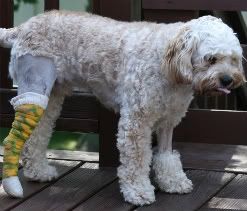
Amazingly, he walks quite nicely, even with a recently repaired knee. He ate dinner, peed and pooped, got his pain pill, and promptly fell asleep. He has to be carried outside to do his duty and don't you know - it's raining, so he has to wear a plastic booty over his bandage.

These Instructions Are Demanding
The post surgery instructions are both demanding and conservative, but we have to follow them. What do ya think - he cannot go up and down stairs, jump onto or off of furniture, and has to be on a leash when he goes outdoors - and these restrictions last FOR 6 WEEKS!

And There's More . . .
He has to wear an e-collar (see the video below).
He has to stay away from Alvin. Besides banning wrestling and other brotherly activity, the discharge nurse said that Alvin cannot lick the sutures (and he will try).
There's pain pills twice a day and an anti-inflammatory once a day.
The bandage comes off after 5-6 days (from 7-13).
The sutures get removed in 12-14 days (from 7-13).
The surgeon sees him in 6 weeks.

BEFORE the surgery (when his patella was dislocating), he was able to do a 28 inch vertical jump onto the table on the deck.

Wonder what it'll be when he's fully recovered!

A Real Short Video
This is a not-too-exciting video of Simon's lack of activity this evening. At least you can see the wonderful bandaging job done in the hospital. The top sutures show because the bandage can't go any higher on the leg (according to the hospital vet tech).

Remember he's on pain medication! He did NOT climb on the couch. We put him on the couch 'cause that's where he's comfortable.


This video was taken with one of the FLIP HD camcorders,
the FLIP UltraHD.

Monday, July 12, 2010

Canine Luxating Patella (Trick Knee) - Simon's Surgery Day

Today I know who's more anxious about Simon's surgery and it isn't Simon.

We took him to the animal hospital at 7:30 AM. He shook when he got there (he was there for X-Rays and apparently it wasn't a pleasant experience) and insisted on being held. Holding a 30 pound dog for any length of time ain't possible, so I sat down with him and waited while he was checked in.

Successful Surgery
At 11:00 AM, the surgeon called with the news that the surgery was routine/successful. They were giving him morphine via an intravenous drip. According to the surgeon, if he progresses as expected, he'll be coming home Tuesday afternoon.

We set up his pen to keep him away from stairs and furniture he can jump onto.

The other party affected by the surgery is Simon's bro - Alvin.
He kept looking for Simon all day, didn't eat his dinner, and finally woke up after I gave him a bone to chew on and guard. He's in dog heaven 'cause Simon's not here to challenge him for the bone. The picture is Alvin guarding his bone against an imaginary threat.

9:00 PM Simon Update
Good news. Simon has just been taken off his morphine drip. It has been replaced with fluids. He will get more morphine tonight if he's uncomfortable. He's alert and responding to the vet tech who said he's "a sweet dog," something we've heard more than once.

Sunday, July 11, 2010

Canine Luxating Patella: Simon Scheduled For Surgery 7-12-2010


Sir Simon The Sad will undergo corrective surgery for canine luxating patella tomorrow (7-12-2010). His hospital stay - 3 days.

Thanks to the advice of chazhound.com/forums (http://www.chazhound.com/forums/t118211/) forum members and his breeder, I have been taking his temp for the past several days so I have a benchmark to figure out if he has a fever post surgery. I've also been trying to catch him limping so I can video his current condition (The Flip UltraHD camcorder comes in handy A LOT).

Finally caught a short video of the limp Simon develops when his knee dislocates. Watch the first few steps in this video . . .


We prepared his food and treats for the animal hospital stay. If he wants to eat, at least he'll have familiar food instead of "hospital food." He can't eat after 12:00 midnight (Sunday) but can drink water.

To all those dog owners out there, please wish Simon a pain-free smooth recovery!


The video shown in this post was taken with one of the FLIP HD camcorders, the UltraHD.

Saturday, June 26, 2010

Canine Luxating Patella - The Surgeon Explains Simon's Surgery


We had a discussion (June 25) with Simon's surgeon about his trick knee (canine luxating patella). His symptoms are getting worse, so we opted for surgery as soon as possible for two reasons:

1. Over time, he will develop arthritis. It's not a concern this moment, but without surgery, he will have problems with an arthritic knee.

2. Dogs with a luxating patella often injure their cruxiate ligaments because of the stress of a dislocating kneecap.

Simon's Symptoms
In case you're wondering - he's showing (or we are better at noticing), these symptoms:
  • Occaisonally he will limp because the kneecap has dislocated. The limp lasts as long as it takes for him to pop it back into place.
  • When he lies down, he groans as if in pain.
  • It takes him a while to get into pooping position (the knees are flexed).
  • He falls up stairs (and has since he was a pup).
Frankly, he's had this issue since he was born, but it's getting worse now that he's more mature. His condition is complicated by the fact he's grown from 9 to 29 pounds since we got him in August of 2009. That's a big growth spurt for a Cockapoo originally estimated to be 20 pounds tops at maturity. He's really not the clumsy puppy we thought he was, just a pup with a trick knee.

More Facts About Luxating Patella From The Surgeon
We asked a lot of questions of the surgeon - this is a family member who's having knee surgery and we wanted to be sure we were doing the right thing for Simon.

So here's a few facts about the surgery -

In Simon's case, the kneecap dislocates medially - to the inside of his right knee. It dislocates (moves out of its groove) because the ligament holding the kneecap in place attaches to protrubing bone in his lower leg bone slightly off center. This condition (off center attachment) was probably present at birth.

During the surgery, the protruding bone (and ligament) will be cut and re-attached in the correct position with a pin. Then the ligaments on the side of his knee will be tightened.

Total surgery time - 30 minutes.

Total time under anesthesia - about an hour.

More about Simon's condition (canine luxating patella) in future posts . . .